Relations with the Cree Nation

Inauguration of the Tommy‑Neeposh lookout
A complex founded on a sustainable relationship
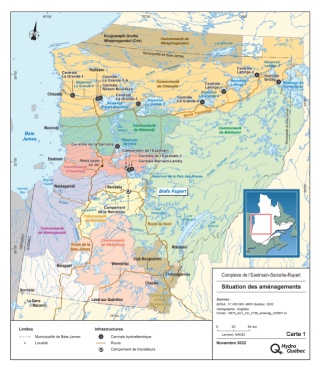
Located in the heart of the Eeyou Istchee Baie-James region of Québec, the Eastmain‑Sarcelle‑Rupert complex is a next-generation complex that was built in collaboration with the Crees at every stage of the project’s life cycle. This innovative approach made it possible to redefine the way in which coordination, consultation and participation is done with Indigenous stakeholders. It has also made the Eastmain‑Sarcelle‑Rupert complex the cornerstone of a new partnership between Hydro-Québec and the Crees of Eeyou Istchee.
A longstanding and fruitful relationship despite difficult beginnings

Ted Moses, Thierry Vandal and André Caillé at the signing of the agreement with Hydro‑Québec and SEBJ.
James Bay and Northern Québec Agreement
The relationship between Hydro‑Québec and the Crees, which has had its ups and downs, has long been plagued by conflict and distrust. The Crees were dissatisfied with the implementation of the James Bay and Northern Québec Agreement, a modern treaty that provided the framework for the first two phases of development of the La Grande complex. Failures had prompted the Crees to take legal action, in particular against the Québec government, Hydro‑Québec and the Société d’énergie de la Baie James.
The Paix des Braves
It took several decades for the rift in the relationship to improve, which it did further to ongoing dialogue and the signing of a new nation‑to‑nation social contract called the Paix des Braves (peace among braves). The historic agreement, ratified on February 7, 2002, which the Cree Nation approved by referendum, redefined relations between the Québec government and the Crees. It also made it possible to wipe the slate clean and look to the future.
Once dialogue resumed at the end of the 1990s and this new social contract was signed, the Crees were able to give their prior, free and informed consent to begin the study process, provided that environmental legislation was respected. In the wake of the Paix des Braves, Hydro‑Québec and the Crees signed nine agreements, including the Boumhounan Agreement, which provided the framework for the Eastmain‑1‑A/Sarcelle/Rupert project. A new chapter of collaboration and partnership thus began.
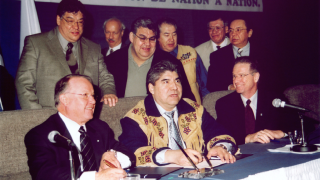
Signing of the Paix des Braves
Innovative approach to social acceptability
After more than a quarter‑century of conflict and distrust, Hydro‑Québec and the Crees are now determined to maintain harmonious relations. Their partnership, which focus on economic and environmental aspects, has four cornerstones:
- Stakeholder participation in the early stages of environmental impact assessments
- Establishment of coordination structures and mechanisms
- Enhancing the pool of qualified workers and local development
- Provision for operational tools and financial means at every step of a project’s life cycle
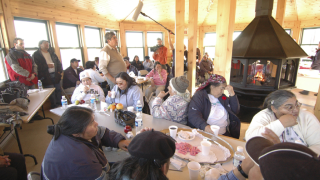
A traditional feast held at the Eastmain workcamp
-
Participation in the early stages of the project
A relationship based on mutual respect
Long before the ground was broken on the future Eastmain‑1‑A/Sarcelle/Rupert project, a joint committee was formed to study its impact on the biophysical and human environments. In addition to Hydro‑Québec representatives, the Boumhounan Committee was made up of representatives appointed by each of the Cree communities affected by the project and by other Cree administrative bodies.
A consent‑based approach was established to approve study mandates, consultants and study reports, as well as study results and conclusions. The Crees thus took part in every step of the impact assessment process. With this approach, Hydro‑Québec ensured that its project was socially acceptable before launching the environmental impact assessment process. The Crees also played a role in determining the project design and how the impacts would be assessed.
With the creation of coordination mechanisms and structures, the aim was to put an end to past conflicts that had tainted the relationship between Hydro‑Québec and the Crees and establish a relationship focusing on the future and based on mutual respect, good faith, reconciliation, partnership, genuine Cree participation and mutually beneficial social and economic arrangements.

Signature of the agreement on the resumed use of the territory
-
Reappropriation of the territory by the Crees
Despite the partnership’s success, the Cree communities affected by the project still had to face the residual impacts of the project on a daily basis. Concerned about how their descendants would cope with these impacts without the resources they needed to adapt, the Crees reached an historic agreement with Hydro‑Québec to resume use of the territory after the structures were built.
The project’s three social acceptability measures
The agreement provides for the three following measures to ensure the long-term social acceptability of the project:
- The creation of a reappropriation and continuation of land use fund. The fund consists of annually indexed annuities paid by Hydro‑Québec for as long as the Rupert’s partial diversion remains in effect.
- The taking on by the Crees of Hydro‑Québec’s obligations pertaining to the human environment. However, Hydro‑Québec remains responsible for its obligations to the regulatory bodies that approved the project.
- The introduction of a mechanism by which the Crees can evaluate their level of satisfaction with the efforts made by Hydro‑Québec to meet its obligations to the Crees and regulatory bodies over the project’s entire life span.
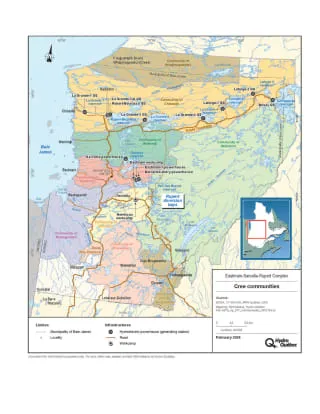
Map of affected communities
Monitoring committee
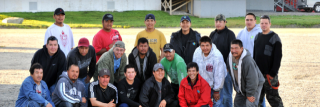
Group of Cree workers
The mandate of the Cree‑Hydro‑Québec Monitoring Committee is to provide a forum where representatives of the Cree Nation Government (Eeyou Istchee) can participate in discussions on environmental issues of importance to them.
Cree representatives are also responsible for:
- Disseminating information in their respective communities regarding Hydro‑Québec’s studies and programs/li>
- Coordinating support for trappers and tallymen
- Acting as advisors
- Disseminating information on mitigation measures
Land use by the Cree Nation

Tallymen, Sarcelle jobsite, 2011
About 30 of the Crees’ 297 traplines are found in the area affected by the project. The creation of the Rupert diversion bays mainly affects four traplines in the Cree Nation of Mistissini and two in the community of Nemaska. Reduced flow in the Rupert affects traplines in the communities of Nemaska and Waskaganish, whereas the increased flow downstream of Eastmain‑1 and Bernard‑Landry generating stations affects traplines in the communities of Eastmain and Wemindji.
Hydro‑Québec and the affected tallymen agreed to replace certain camps and build new access roads, boat ramps and portages, and to develop wetlands for goose hunting so that hunting, fishing and trapping activities could continue.
- In most cases, these measures were entrusted to the tallymen and their families.
- During construction, the tallymen were regularly kept informed of the activities planned on their respective traplines and asked to participate in all surveys, inventories and studies taking place there.
- After the diversion, a follow‑up program to last up to 15 years was implemented to determine how users were adapting to the new environmental conditions.
Regional economic spinoffs

Cree contractor on the Sarcelle construction site
Measures to promote economic spinoffs
The Boumhounan Agreement provides for various measures to facilitate participation by Cree businesses and workers:
- Negotiation of direct contracts worth $5 million at the study stage
- Negotiation of direct contracts worth $240 million at the construction stage
- Representations to the Commission de la construction du Québec to facilitate Cree hiring
- Hiring of a Cree employment counsellor
- A $1.5 million fund for classroom and on‑the‑job training for Cree workers
- Awarding of contracts worth $290 million in the operation phase
Measures were also taken to increase the project’s spinoffs in Jamésie:
- Priority given to regional businesses in contracts and procurement under $1 million
- Regional subcontracting clause to encourage large contractors to procure supplies locally
- Hiring of a jobsite agent to promote Jamesian businesses
- A 50‑year financial partnership with the municipality of Eeyou Istchee Baie‑James
Awarding of contracts worth $126 million in the construction phase.