
Environmental assessment process

Environmental protection
The following criteria influenced the design of the generating stations and the partial diversion of the Rupert.
- Minimal flooding of land
- Introduction of an ecological instream flow regime at the Rupert’s derivation point
- Maintenance of flow equivalent to naturally occurring flows in the Lemare and Nemiscau rivers
- Building of hydraulic structures on the Rupert to protect fish communities and habitats, preserve the river’s natural appearance and maintain navigation and land use
- Maintain Mesgouez, Champion and Nemiscau lakes at their natural levels
- Safeguard the supply of drinking water in Waskaganish
- Maintain Lac Sakami at the level agreed upon
- Guarantees, assurances and commitments in the Boumhounan Agreement
Draft‑design studies (2002‑2007)
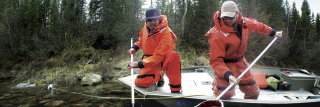
Follow‑up of lake sturgeon
Impact assessment
To ensure the harmonious integration of the facilities into the environment, Hydro‑Québec took into account the concerns expressed by land users and the government departments, in particular members of the Cree communities. The numerous studies before the project was carried out provided valuable knowledge about wildlife, plants, land use, archaeology, navigation and the region’s economic, social and cultural environment. These constitute the baseline information on the environment. With the ensuing impact analysis, the project’s impacts on the environment were assessed and the necessary measures to mitigate them were established.
Assessment processes
The project was subject to the environmental assessment processes prescribed in Chapter 22 of the James‑Bay and Northern Québec Agreement (JBNQA) and Chapter II of the Québec Environment Quality Act and the Canadian Environmental Assessment Act. The project was reviewed by both the Provincial Review Committee (COMEX), which reports to the Provincial Administrator of Section 22 of the JBNQA, and by the now defunct Federal Review Panel, which reported to the federal Minister of the Environment. The 70 authorizations issued by the Minister of Transport, Infrastructure and Communities under section 5 of the Navigable Waters Protection Act allow structures to be built in navigable waters.
Required preliminary steps
Before starting construction, the project had to go through a number of steps, the main ones being:
-
Filing of the project notification
November 29, 2002
-
Public consultations on the directives
From May 28 to June 11, 2002
-
Final directives for the preparation of the environmental impact statement obtained
August 2003
-
Filing of the impact statement
December 2004
-
Public consultation on the compliance of the impact statement
January 31 to April 30, 2005
-
Filing of responses to questions from review bodies
August 2005 to January 2006
-
Public hearings in the six Cree communities concerned and in Chibougamau and Montréal
March 15 to June 9, 2006
-
Certificate of authorization from the Provincial Administrator of Section 22 of the JBNQA
November 24, 2006
-
Federal approvals obtained from the Minister of Fisheries and Oceans and the Minister of Transport, Infrastructure and Communities
February 2, 2007
During construction (2007–2012)
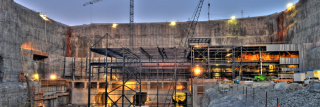
Bernard‑Landry generating station jobsite
Necessary authorizations
During the construction phase, Hydro‑Québec also had to obtain over 1,200 sector‑related authorizations under the Environmental Quality Act, Forest Act, Mining Act and Dam Safety Act, among others.
The certificate of authorization issued by the Provincial Administrator of the JBNQA includes 97 conditions established to protect the natural and social environment affected by the project. The authorization issued by the federal Minister of Fisheries and Oceans under section 35 of the Fisheries Act contains 40 conditions relating to the protection of fish habitats.
Three environmental components
In accordance with the ISO 14001 environmental management standard, Hydro‑Québec ensured that the work was carried out with respect for the environment and in such a way as to cause as little disruption as possible to the activities of land users.
Hydro‑Québec implemented the numerous mitigation measures set out in the environmental impact statement and in the conditions of the authorizations. The goal was to ensure a new environmental balance for the area affected by the work, while making it possible for users of the territory to continue their activities.
Hydro‑Québec continued its environmental studies, in particular on fish, birds and land wildlife, until impoundment. Hydro‑Québec monitored the impact of the construction of structures and roads on land use and on the economic, social and cultural environment of affected populations, including the local Cree communities.
The components covered by the follow‑up program include:
- Biophysical environment – hydrology and hydraulic regime, geomorphology, thermal regime, ice cover and water quality
- Aquatic environment – fish populations and habitat, and locations enhanced for fish
- Land environment – vegetation, land and semi-aquatic wildlife and birds
- Human environment – society and culture in the Cree communities, public health and mercury, land use, navigation, landscape, recreation and tourism, and economic spinoffs
Operation, since 2012
Hydro‑Québec monitored the project’s impacts on the environment and verified the effectiveness of mitigation measures in order to take corrective action, if necessary. The knowledge acquired during the environmental follow-up process provided valuable lessons for other projects.