
Discover the
Eastmain‑Sarcelle‑Rupert complex
A little history
Located in the Nord du Québec administrative region, the Bernard Landry (previously Eastmain‑1‑A) and Sarcelle generating stations, the construction of which began in February 2007, were commissioned in 2012 and 2013. The partial diversion of the Rivière Rupert was completed in November 2009.
Main facilities
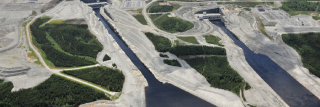
Aerial view of Bernard‑Landry and Eastmain‑1 generating stations
The Eastmain‑1‑A/Sarcelle/Rupert project increased Hydro‑Québec’s output by about 8.7 TWh with the following facilities:
- Bernard‑Landry generating station (originally Eastmain‑1‑A), installed capacity of 768 MW, located near Eastmain‑1 generating station
- Sarcelle generating station, installed capacity of 150 MW, located at the outlet of Opinaca reservoir
- The partial diversion of the Rivière Rupert with four dams, an instream flow release structure and a system of canals to carry some of the water from the Rupert to the two new generating stations, then to Robert‑Bourassa, La Grande 2‑A and La Grande‑1 generating stations
- Two diversion bays upstream of Rupert dam, covering about 346 km2 and connected by a 2.9‑km-long tunnel
- Eight hydraulic structures (weirs, spurs and rock blankets) downstream of Rupert dam to maintain the water level along nearly half of the Rupert.
Advantages and description
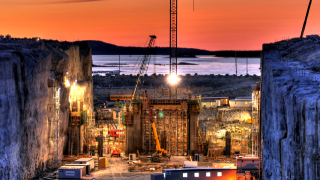
Sarcelle jobsite for construction of the Sarcelle generating station
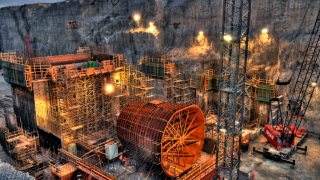
Construction of Bernard‑Landry generating station
Advantages
Optimization of the generating capacity
The main advantage of the Eastmain‑1‑A/Sarcelle/Rupert facilities is that they optimize the generating capacity of some existing generating stations, adding 8.7 TWh to the generating fleet’s output. Once it has driven the turbines of Eastmain‑1 or Bernard‑Landry and Sarcelle powerhouses, the water continues on to Robert‑Bourassa, La Grande‑2‑A and La Grande‑1 generating stations.
Integrating the power generated
To integrate the output of the new generating stations into the grid, a 315‑kV line was built between Eastmain‑1 and Bernard‑Landry switchyards (in 2011), and another between Sarcelle and Eastmain‑1 switchyards.
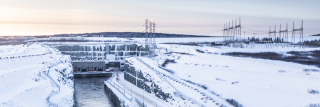
Bernard‑Landry generating station and the switchyard in winter
Description
Generating stations
Bernard-Landry generating station (originally Eastmain‑1‑A), with an installed capacity of 768 MW and a maximum flow of 1,344 m3/s, is located near Eastmain‑1 generating station. Sarcelle generating station, with an installed capacity of 150 MW and a maximum flow of 1,380 m3/s, is located at the outlet of Opinaca reservoir, and has a mean annual diverted flow of 452 m3/s.
Other facilities:
- Partial diversion of the Rupert includes four dams, an instream flow release structure and a system of canals to carry some of the water from the Rupert to the two new generating stations, then to Robert‑Bourassa, La Grande 2‑A and La Grande‑1 generating stations
- 74 dikes
- 2 diversion bays upstream of Rupert dam, covering about 346 km2 at their maximum level and connected by a 2.9‑km‑long tunnel
- 8 hydraulic structures (weirs, spurs or rock blankets) downstream of Rupert dam to maintain the post-diversion water level along nearly half of the Rupert (see Map 3), all of which were completed in 2010
- 1 spillway on the Rupert at the dam site, which also controls the instream flow
- 5 other instream flow release structures built into some of the retaining structures in the diversion bays (Nemiscau‑1, Nemiscau‑2, Ruisseau‑Arques, Lemare and LR‑51‑52)
- 1 2.9‑km‑long transfer tunnel between the two diversion bays, where the maximum authorized flow is 800 m3/s
- 9 canals (4 in the forebay and 5 in the tailbay) about 7‑km long, to facilitate adequate water flow in the different parts of the diversion bays
History and key moments

Construction of the transfer tunnel
Eastmain‑Sarcelle‑Rupert Complex
1993: The Conseil exécutif du gouvernement du Québec issued an order-in-council authorizing Hydro‑Québec to build the Eastmain‑1 hydroelectric project. The Ministère de l’Environnement (MENV)1 then issued a certificate of authorization to build the generating station under section 22 of the Environment Quality Act (EQA)
1 Now called the Ministère de l’Environnement et de la Lutte contre les changements climatiques, de la Faune et des Parcs.
From 1998 to 2001: Hydro‑Québec developed a preliminary version of the project in collaboration with the Crees.
February 2002: With the signing of the Paix des Braves, the Crees in the Baie‑James region gave their consent to the project, subject to the conditions set out in the Boumhounan Agreement, and on condition that the project be made subject to applicable legislation. The Nadoshtin Agreement, a cooperation agreement between the Crees, Hydro‑Québec and SEBJ regarding the Eastmain‑1 hydroelectric development, sets out several provisions for environmental follow‑up of the project and provides for Cree participation in environmental follow‑up studies.
From February 2002 to December 2004: Hydro‑Québec, in collaboration with the Crees, optimized the project’s design and conducted the environmental impact assessment in accordance with the directives of the governments of Québec and Canada.
December 2004: Hydro‑Québec Production filed the environmental impact statement for Bernard‑Landry (then Eastmain‑1‑A) and Sarcelle generating stations and the Rupert diversion (Hydro‑Québec, 2004) with government authorities.
April 2005: The Master Plan for the Eastmain‑1 Environmental Follow‑up Program (PSE‑EM1, SEBJ and Hydro‑Québec, 2005) was filed with the Ministère du Développement durable, de l’Environnement et des Parcs (MDDEP)1 after the Plan was approved by the Crees.
June 2006: Hydro‑Québec developed follow‑up methods describing the objectives, study area, proposed methods, follow‑up schedule and the source of the commitments.
November 24, 2006, and February 7, 2007: Following a rigorous environmental impact assessment process, Hydro‑Québec secured the government approvals necessary to carry out the project to build Robert‑Landry and Sarcelle generating stations and the Rupert partial diversion. Deeming the project to be environmentally, socially, technically and economically acceptable, the Ministère du Développement durable, de l’Environnement et des Parcs (MDDEP) authorized it in November 2006. Fisheries and Oceans Canada (DFO) and Transport Canada (Transport, Infrastructure and Communities Portfolio) followed suit in February 2007.
September 2007: An Environmental Monitoring Committee was set up and an environmental follow‑up program was implemented.
December 3, 2009: The Rupert partial diversion, which began operation on November 7, 2009, channels some of Rupert’s flow to Eastmain‑1 powerhouse and the two new generating stations, and then to Robert‑Bourassa, La Grande‑2‑A and La Grande‑1 generating stations.
January 2012: Bernard‑Landry generating station is commissioned.
December 2013: Sarcelle generating station is commissioned.
1 Now called the Ministère de l’Environnement et de la Lutte contre les changements climatiques, de la Faune et des Parcs.
Infrastructures and facilities
To build the complex, Hydro‑Québec had to set up temporary and permanent infrastructures and facilities:
- 137 km of access roads to the structures
- A permanent, 40‑km road between Muskeg substation and the Nemiscau‑Eastmain‑1 road
- Temporary work camps to house workers
- Work areas, borrow pits, etc.
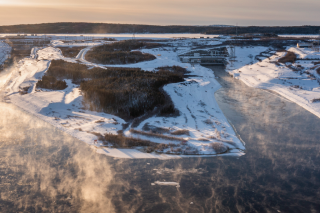
View of Eastmain‑1 and Bernard‑Landry generating stations

Workers at the Eastmain‑1‑A‑Sarcelle‑Rupert jobsite
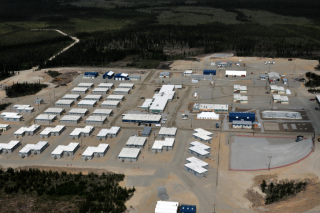
Sarcelle workcamp
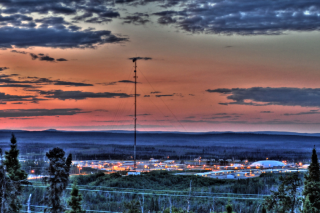
Eastmain workcamp