
Photovoltaic solar power
Hydro‑Québec is focusing on photovoltaic solar power development to strengthen Québec’s energy self‑sufficiency based on an evolving, rigorous and affordable approach.

Why the focus on solar power?
Solar power’s role in the energy transition
As an energy source that is complementary to hydropower and wind power, solar power plays a role in the energy transition by helping us diversify the solutions we adopt to ensure Québec’s energy self‑sufficiency.
Although more than 99% of the electricity Hydro‑Québec generates is from renewable sources and therefore advantageous with regard to the resulting carbon footprint, solar power remains an interesting option because it helps reduce our reliance on fossil fuels.
It is nevertheless important to note that the carbon footprint associated with solar panels depends largely on where the components are manufactured and which energy source is used in the manufacturing process.
Global growth of solar power
Solar power is expected to experience strong growth globally by 2050 and represent up to 40% of the world’s renewable energy generation, surpassing both hydropower and wind power.
This growth is due, in particular, to technological advances of new materials that make solar panels increasingly efficient while lowering manufacturing costs. As a result, in 2024, countries such as Germany, Japan and Denmark used the sun to generate between 10% and 12% of their electricity. In the state of Massachusetts, solar power generation was as high as 16%.
The cost of implementing solar power in Québec is comparable to that of countries such as Germany and France and remains competitive when compared with the implementation costs of renewable natural gas facilities.
Given the increasingly rapid pace of solar power integration, Hydro‑Québec must stay abreast of the changes in order to adapt and remain at the forefront of the energy transition.
The advantages of solar power
Solar power has many advantages and can play a more important role in the energy transition alongside Québec’s existing energy sources.

Energy complementarity
Solar power complements hydropower, with our hydroelectric reservoirs storing energy while the sun’s variable energy outputs meets demand.

Installation flexibility
As part of procurement projects, solar panels are easy to install near consumption areas within relatively short timeframes (18 months to 5 years). For solar self‑generation projects, timelines may vary from a few weeks to a few months, depending on the installed capacity.

Supplying electricity to remote off‑grid systems
Solar power helps reduce fuel consumption related to powering remote off‑grid systems.

Technological advances and reduced costs
Generation costs have decreased worldwide in the past 15 years, making solar power increasingly affordable.
Québec’s solar potential
Favourable weather conditions
When it comes to equivalent sun hours, Québec’s solar potential is favourable to the development of solar power given that the amount of sunlight is greater than in certain countries, such as Germany, that have already integrated solar power.
What’s more, cold temperatures and the reflective quality of snow improve the performance of solar panels.

| Location | Annual Sunshine Hours |
|---|---|
| Morocco | 3,103 |
| Ontario | 2,190 |
| Québec | 2,154 |
| Alberta | 2,232 |
| France | 2,044 |
| Germany | 1,716 |
Reference: https://www.worlddata.info/climate-comparison.php
Solar power already in action
Hydro‑Québec has commissioned two solar farms located in La Prairie and in Varennes, which generate close to 16 GWh of solar power per year. This is equivalent to the electricity used by 1,000 households. These solar farms have shown that solar power is well suited to Québec’s climate and the transmission system.
The knowledge gained from this experience will enable us to move forward with our plan to develop larger‑scale solar farm projects.
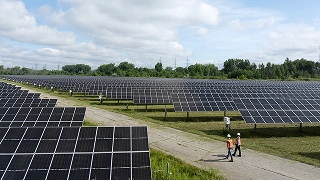
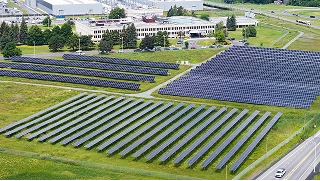
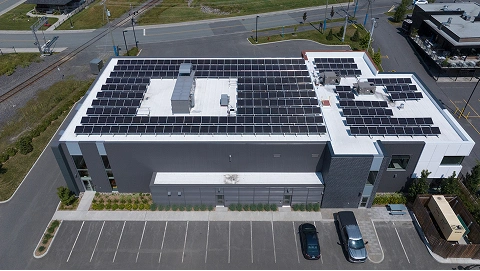
To ensure its energy self-sufficiency and manage its energy mix, Hydro‑Québec aims to develop 3,000 MW of solar power in Québec by 2035.
Solar development approach
With this approach, Hydro‑Québec is able to track technological advances, optimize costs and gain a better understanding of the solar power yield while maximizing economic spinoffs for Québec and host communities, including First Nations and Inuit communities.
Developing small‑scale solar farms through a call for tenders
This step will help us develop Québec’s new solar ecosystem in the short term while gathering additional market data with a view to more extensive development in the future.
Exploring larger‑scale solar farm development
For solar farms with capacities greater than 25 MW, Hydro‑Québec aims to develop projects in collaboration with industry developers, host communities and First Nations and Inuit communities.
Promoting the self‑generation option among its customers
Through a new grant, Hydro‑Québec wants to encourage residential and business customers to have solar panels installed on their buildings.
Building facilities that blend harmoniously into their host environments
Each project is carefully developed to ensure that the facilities blend into their host environments as much as possible. Throughout the process, we organize public consultations and apply a rigorous environmental approach designed to help us understand concerns, protect the environment and adapt the projects to local realities. For more information about our entire process, including the step‑by‑step progress of individual projects, click on the link below.