
Greenhouse gas emissions and reservoirs
Impoundment of hydroelectric reservoirs induces decomposition of a small fraction of the flooded biomass (forests, peatlands and other soil types) and an increase in the aquatic wildlife and vegetation in the reservoir.
The result is higher greenhouse gas (GHG) emissions after impoundment, mainly CO2 (carbon dioxide) and a small amount of CH4 (methane).
However, these emissions are temporary and peak two to four years after the reservoir is filled.
During the ensuing decade, CO2 emissions gradually diminish and return to the levels given off by neighboring lakes and rivers.
Hydropower generation, on average, emits 35 times less GHGs than a natural gas generating station and about 70 times less than a coal-fired generating station.
Many years ago, Hydro-Québec decided to make use of the province's water resources to meet the demand for electricity. This policy has contributed greatly to Québec's excellent record on greenhouse gas emissions.
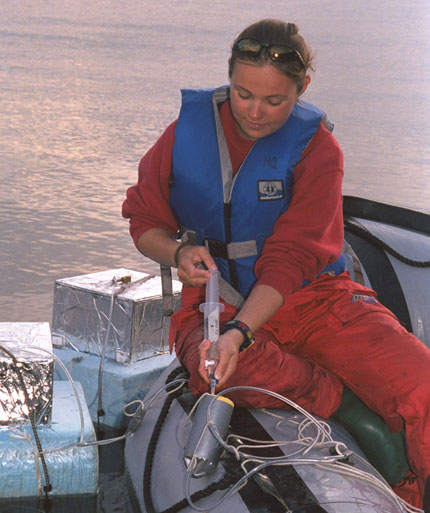
In partnership with universities, research centres and other electric utilities, Hydro-Québec has conducted research on greenhouse gases since 1993.
The objectives of these studies are to:
- Improve understanding of the impacts of our reservoirs on GHG emissions.
- Learn about the processes that cause GHG emissions.
- Monitor changes in GHG emissions in new projects.
- Compare GHG emissions from hydropower with those from other energy sources.
- Obtain potential CO2 emissions credits in the future Canadian carbon market.
Specialized documentation
Low GHG emissions
Videos on GHG
Main videos - Energy and GHG
- Quebec’s electricity has a low carbon footprint and we can prove it!
- GHG emissions and Québec hydro-power, Where do they come from?
- Measuring GHG emissions in aquatic environments
- How are GHGs measured in terrestrial environments?
- Reservoirs and GHG emissions: The advantage of our northern climate
- How do we compare electricity generation methods?
- Transmission line rights-of-way and their carbon impact
A word from our specialists
- What is the greenhouse effect?
- Where do the GHGs emitted by reservoirs come from?
- Do reservoirs only emit GHGs temporarily?
- Does Québec emit a lot of methane?
A word from our partners
GHG from reservoirs
- Why are GHGs from the Romaine measured?
- What does the research chair study?
- Are boreal ecosystems different from other ecosystems?
- Does the research chair collect a lot of data?
- Long version
Hydroclimatic impacts
- What is the water footprint of reservoirs?
- How is the net evaporation of a hydroelectric reservoir measured?
- What are the consequences of climate change on the water footprint of Hydro-Québec's reservoirs?
- What role does ice play in the region's energy balance after the creation of our reservoirs?
- How water footprint research can help improve forecasts of the hydroelectric potential of reservoirs?
Footprint of transmission line corridors
- What is the main goal of your research with Hydro-Québec?
- How do carbon dynamics function within transmission line corridors?
- Why is it important to measure forest carbon to assess the impact of transmission line corridors?
- How do you measure soil respiration and carbon input from organic matter?
Net GHG emissions from la Paix des Braves reservoir
Technical and scientific reports
- Demarty, M., D. Marchand and A. Tremblay. 2012. Centrales de l'Eastmain-1A et de la Sarcelle et dérivation Rupert – Étude des flux de gaz à effet de serre – Résultats été 2012. (Eastmain-1-A and Sarcelle powerhouses and Rupert diversion – Study of greenhouse gas fluxes – Summer 2012 results). Joint report by Environnement Illimité Inc. and Hydro-Québec Production, Direction – Gestion des actifs et conformité réglementaire. 38 p and app.
- Marchand, D., M. Demarty, and A. Tremblay. 2012. Aménagement hydroélectrique de l'Eastmain-1 – Étude des flux de gaz à effet de serre – Résultats été 2012. (Eastmain-1 Hydroelectric Development – Study of greenhouse gas fluxes – Summer 2012 results). Joint report by Environnement Illimité Inc. and Hydro-Québec Production, Direction – Gestion des actifs et conformité réglementaire. 46 p and app.
- Marchand, D., M. Demarty and A. Tremblay. 2012. Systèmes automatisés de mesure des gaz à effet de serre – Eastmain-1, Robert-Bourassa et Rivière-des-Prairies – Résultats 2011-2012. (Automated greenhouse gas measuring systems – Eastmain-1, Robert-Bourassa and Rivière-des-Prairies – 2011–2012 Results). Joint report by Environnement Illimité Inc. and Hydro-Québec Production, Direction – Gestion des actifs et conformité réglementaire. 39 p
- Bastien, J., M. Demarty and A. Tremblay. 2010. Étude des flux de gaz à effet de serre des milieux aquatiques de la Côte-Nord et de la Mauricie – Résultats été 2010. (Study of the greenhouse gas fluxes of aquatic environments in the Côte-Nord and Mauricie regions – Summer 2010 results). Joint report by Environnement Illimité Inc. and Hydro-Québec Production, Direction – Barrages et environnement. 54 p and app.
Monograph
- Tremblay, A., L. Varfalvy, C. Roehm and M. Garneau. 2005. "Greenhouse Gas Emissions: Fluxes and Processes, Hydroelectric Reservoirs and Natural Environments (Émissions de gaz à effet de serre : Flux et processus, réservoirs hydroélectriques et milieux naturels)". Environmental Science, New York, Springer. 732 p. Abstract [PDF 180 Kb – in French only]
This monograph is available for consultation at Hydro-Québec's environment and communities documentation centre.
It can also be purchased from www.amazon.ca or directly from the publisher.
Scientific articles
- Teodoru, C. R., J. Bastien, M.-C. Bonneville, P. del Giorgio, M. Demarty, M. Garneau, J.-F. Hélie, L. Pelletier, Y. T. Prairie, N. Roulet, I. Strachan and A. Tremblay. 2012. "The Net Carbon Footprint of a Newly Created Boreal Hydroelectric Reservoir." Global Geochemical Cycles, Vol. 26, GB2016, DOI:10.1029/2011GB004187.
- Bastien, J., M. Demarty and A. Tremblay. 2011. "CO2 and CH4 Diffusive and Degassing Emissions from 2003 to 2009 at Eastmain 1 Hydroelectric Reservoir, Québec, Canada." Inland Waters (1), p 113-123. DOI:10.5268/IW-1.2.349.
- Demarty, M., J. Bastien and A. Tremblay. 2011. "Annual Follow-up of Gross Diffusive Carbon Dioxide and Methane Emissions from a Boreal Reservoir and Two Nearby Lakes in Québec, Canada." Biogeosciences, vol. 8, p 41-53.
- Demarty, M., J. Bastien, A. Tremblay, R. Hesslein and R. Gill. 2009. "Greenhouse Gas Emissions from Boreal Reservoirs in Manitoba and Québec, Canada, Measured with Automated Systems." Environmental Science and Technology, vol. 43, no 23, p 8905-8915.
- Prairie, Y. T., P. A. del Giorgio, C. L. Roehm and A. Tremblay. 2009. "Insights on Riverine Metabolism from Continuous Measurements of CDOM Fluorescence In Eastmain-1 Reservoir, Quebec." Verh. Internat. Verein. Limnol. Vol. 30, Part 10, p 1545-1548.
- Tranvik, L. J., J. A. Downing, J. B. Cotner, S. A. Loiselle, R. G. Striegl, T. J. Ballatore, P. Dillon, K. Finlay, K. Fortino, L. B. Knoll, P. L. Kortelainen, T. Kutser, S. Larsen, I. Laurion, D. M. Leech, S. L. McCallister, D. M. McKnight, J. M. Melack, E. Overholt, J. A. Porter, Y. Prairie, W. H. Renwick, F. Roland, B. S. Sherman, D. W. Schindler, S. Sobek, A. Tremblay, M. J. Vanni, E. von Wachenfeldt, E. D. Wachenfeldt and G. A. Weyhenmeyer. 2009. "Lakes and Reservoirs as Regulators of Carbon Cycling and Climate." Limnology and Oceanography, vol. 54 (6 part 2), p 2298-2314.
Outreach documents
- Calculating the carbon footprint of Québec hydropower using life cycle assessment (LCA) [PDF 5.1 MB]
- Greenhouse gas emissions and hydroelectric reservoirs [PDF 1.23 MB]
- Differences-Greenhouse gas emissions-Boreal and tropical regions reservoirs [PDF 1.26 MB]
- Techniques for measuring reservoir greenhouse gas emissions [PDF 3.5 MB]
- Automated system for GHG measurement in the water turbined in our generating stations [PDF 2.11 MB]
See also
- Sustainable Development Plan
- Biodiversity strategy and initiatives
- Summaries of environmental knowledge
- Net reservoir evaporation
- Greenhouse gas emissions and reservoirs
- GHG emissions and Hydro-Québec electricity
- Hydro-Québec and the mercury issue
- Hydroelectric developments and fish
- Life cycle assessment at Hydro-Québec
- Environmental follow-up
- Renewable energy sources: current state of knowledge
- Climate Change Adaptation Plan
- Hydropower Sustainability Standard certification