
Self-generation
Discover self‑generation, its applications, its advantages and the steps of a project.
What is self-generation?
Self‑generation refers to generating your own electricity to meet part or all of your energy needs while remaining connected to the Hydro‑Québec grid.
Growing interest in self‑generation
The main motivations are as follows:
- To be more self-sufficient, particularly in the event of an outage
- To increase the value of the residence or business
- To be an early adopter of technology
How does self-generation work?
In addition to using electricity supplied by Hydro‑Québec, you use electricity that you generated or energy stored using equipment you own and operate.
Given that your equipment is connected to the Hydro‑Québec grid, the energy exchanges occur according to the communicating vessels principle:
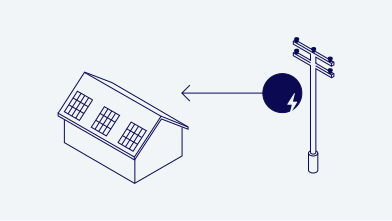
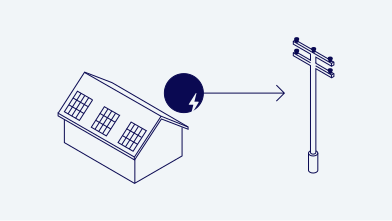
Examples of equipment

Generation
- Solar panels
- Wind turbine
- Hydroelectric turbine
- Forest biomass plant

Storage
- Battery that stores energy for future use
- Bidirectional EV charging station (V2G) enabling the consumer to use the energy stored in the EV battery

Backup power supply
- Inverter, battery or generator that automatically takes over in the event of an outage to power essential appliances or maintain key functions.
Project timeline
Are you thinking of taking the leap and becoming a customer-generator? Hydro-Québec is there to provide guidance to ensure your project is conducted in a structured and safe manner.
Never connect self-generation equipment yourself.
A non‑regulatory installation has the potential to cause a fire, serious injury or even death.
Personal safety first and foremost.
Preparation
Key actions before getting started
Make sure you are eligible
- Residential customers: You must own and operate the self-generation equipment as well as the site where it will be installed.
- Business customers: You must own and operate the self-generation equipment. If you rent the site where the equipment will be installed, the building owner must submit the application.
Learn about the current standards
To avoid any unpleasant surprises, be sure to check the municipal regulations or other federal and provincial standards regarding the installation and use of self-generation equipment.
Find out what offers and subsidies are available
Since March 31, 2026, Hydro‑Québec is offering a grant for the purchase of solar panels.
Choose the portal that corresponds to the building's purpose:
Steps
Here is an overview of the most common steps for a self-generation project.
It is recommended to wait for conditional acceptance from Hydro‑Québec before purchasing your self‑generation equipment.
It is mandatory to obtain official authorization from Hydro‑Québec before connecting your self‑generation equipment to the grid.
-
Hiring an electrical contractor
CUSTOMER
For all self-generation projects, the equipment must be connected to the grid by an electrical contractor that you are responsible for hiring. Make sure that the electrical contractor you hire is a member of the Corporation des maîtres électriciens du Québec (CMEQ) [in French only].
For larger or more complex projects, the expertise of an engineering consulting firm may be required.
-
Submitting an application
ELECTRICAL CONTRACTOR
The electrical contractor assesses and plans the project with you before submitting an application to Hydro‑Québec for the installation of self‑generation equipment.
-
Assessment of the application
HYDRO-QUÉBEC
- Hydro‑Québec records the application and, when necessary, communicates with the electrical contractor to address the key points in processing the application.
- Hydro‑Québec carries out a grid hosting capacity analysis. If the area already has a high concentration of customer-generators, your application may be put on hold until the grid can take on more.
For the vast majority of self-generation projects, Hydro-Québec does not charge a connection fee. However, more complex projects can require, at your expense, an interconnection study and system modifications. No costs will be incurred without your prior approval.
-
Conditional acceptance
HYDRO-QUÉBEC
If your project is accepted, Hydro‑Québec will provide you with a conditional acceptance subject to verification of the installation by the master electrician.
-
Work and compliance testing
ELECTRICAL CONTRACTOR
Once the self-generation equipment is installed, the electrical contractor carries out the compliance testing and sends their signed verification report to Hydro-Québec.
-
Official authorization
HYDRO-QUÉBEC
If the verification report is found to be satisfactory, Hydro-Québec issues its official authorization.
Net metering tariff options
Under certain conditions, it is possible to obtain credits in exchange for your surplus production.
Following the analysis of your project, the appropriate tariff option will be proposed to you for calculating your energy exchanges with the grid.
Self-generation connected to the main grid
Self‑generation connected to an off‑grid system
Self‑generation without compensation plan
It is possible to self-generate your electricity without being eligible for the net metering option.
Under certain conditions, energy exchanges with the Hydro-Québec grid are possible, but the surplus energy produced is not credited.